
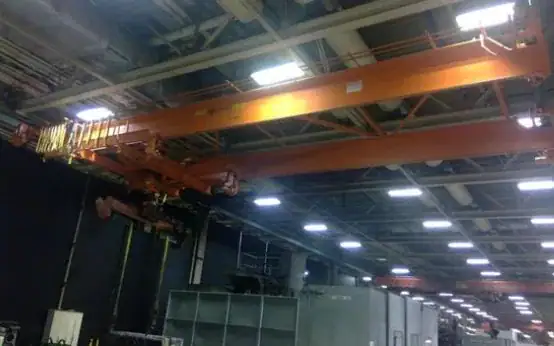
Facility planners evaluating overhead crane systems face a fundamental decision: single or double girder design. This choice affects initial investment, building requirements, lifting capacity, and long-term operational costs. Understanding the single vs double girder crane comparison helps engineers and procurement teams select systems that match facility requirements while optimizing budget and performance.
Both configurations serve material handling needs effectively, but design differences create distinct advantages depending on application requirements, lifting heights, and capacity demands.
What Is a Single Girder Crane?
Single girder cranes utilize one main beam spanning the crane runway. The hoist and trolley travel along the bottom flange of this girder, creating an underhung configuration. This simpler design offers cost advantages and faster installation.
Single Girder Design Characteristics
Single girder characteristics include:
- Structural Configuration: One main beam supporting the hoist and trolley.
- Typical Capacity Range: 250 pounds to 20 tons.
- Span Limitations: Generally economical for spans up to 120’.
- Hook Height: Reduced due to hoist mounting below the girder.
- Weight: Lighter construction reduces building load requirements.
The hoist position below the girder creates the primary limitation: reduced hook height compared to building clearance. Facilities with limited overhead space may sacrifice valuable lifting height with single girder designs.
Double Girder Design Overview
Double girder cranes feature two parallel beams with the hoist and trolley riding on top of the girders. This configuration provides maximum hook height and supports heavier duty applications and capacities.
Double Girder Design Characteristics
Double girder characteristics include:
- Structural Configuration: Two parallel beams with a top-running trolley.
- Typical Capacity Range: 5 tons to 500+ tons.
- Span Capability: Suitable for spans up to 200+ Feet.
- Hook Height: Maximized by positioning the hoist above the girders.
- Service Access: Walkways and platforms for maintenance.
Single vs. Double Girder Cranes: Key Differences
Evaluating single and double girder crane options requires understanding how design differences affect performance, cost, and suitability.
Capacity and Duty Cycle
Single girder cranes suit light-to-moderate-capacity applications with intermittent use. The simpler design handles repetitive lifting within its capacity range but isn’t engineered for continuous heavy-duty service.
Double girder cranes accommodate heavy capacities and rigorous duty cycles. Manufacturing operations running multiple shifts, steel processing facilities, and heavy assembly operations require double girder strength and durability.
Hook Height Considerations
Hook height, the distance from the floor to the hook at its highest position, directly affects usable lifting capability.
- Single Girder: Hook height is limited because the hoist hangs below the beam.
- Double Girder: Hook height is maximized because the hoist rides on top of the beams.
This configuration gains 18–36 inches of additional hook height in typical installations, significant when lifting tall equipment or stacking materials to maximum height.
Initial Investment and Operating Costs
Single girder cranes cost less initially due to simpler structural design, lighter components, and faster installation.
Double girder cranes involve a higher upfront investment but provide advantages in specific scenarios, including:
- Can be lower cost per ton for heavy capacity ranges.
- Reduced maintenance costs through accessible service platforms.
- Extended service life in moderate to severe duty applications.
How to Choose the Right Girder Crane for Your Facility
Selecting between single and double girder configurations requires evaluating multiple factors beyond simple capacity requirements.
Choose single girder cranes when:
- Lifting capacity requirements remain under 15 tons.
- Duty cycle involves intermittent lifting (occasional use).
- Building headroom isn’t critical to operations.
- Initial budget constraints favor lower capital investment.
Choose double girder cranes when:
- Capacity requirements exceed 20 tons.
- Operations demand continuous or frequent lifting cycles.
- Maximizing hook height is critical.
- Facility spans exceed 120 feet.
- Maintenance accessibility affects operational efficiency.
Additional Selection Criteria
Beyond girder configuration, consider:
- Top-Running vs. Underhung: Top-running single girder and double girder designs maximize coverage, while underhung configurations suit facilities with existing structural support.
- Environment: Temperature, humidity, and corrosive atmospheres may dictate specific coatings or components.
Choosing the Right Girder Crane With T&M Cranes
The single vs double girder crane decision affects facility productivity, safety, and long-term operating costs. At T&M Cranes, we help manufacturing facilities and industrial operations evaluate lifting requirements and budget parameters to recommend optimal configurations.
Whether you’re equipping a new facility or upgrading existing material handling, we engineer solutions matching your operational needs.
Ready to determine the right crane configuration?
Contact our team to discuss your lifting requirements. We will evaluate your application and recommend crane systems that optimize performance and value.
Request a quote to explore single and double-girder options tailored to your specific operational requirements.